Archive

  • Visit JGI.DOE.GOV
News & Publications
Home › Blog
Page 1 of 6912345...102030...»Last »

April 9, 2021

Statement on the Use of Genomics Data

Read our Statement on the Use of Genomics Data. [Read More]

April 9, 2021

Statement on the Use of Genomics Data

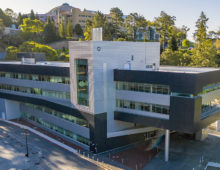
Aerial photo of the IGBBuilding upon the principles for open access in the field of genomics, the JGI recognizes the need to engage the community to inform necessary changes to JGI data policies. [Read More]

December 21, 2020

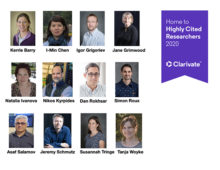
JGI on the 2020 Highly Cited Researchers List

2020 Highly Cited Researchers at the JGICongratulations to the dozen JGI scientists recognized by Clarivate Analytics for being on the 2020 Highly Cited Researchers list! [Read More]

October 28, 2020

JGI Welcomes New UEC Members

(left to right) Kathleen Greenham of the University of Minnesota, Matthias Hess of the University of California, Davis and Kristen DeAngelis of University of Massachusetts-Amherst,The JGI User Executive Committee, which represents the JGI user community, welcomes three new members: Kathleen Greenham, Matthias Hess, and Kristen DeAngelis. [Read More]

October 21, 2020

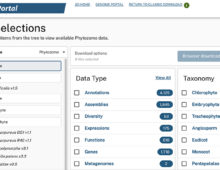
The JGI Data Portal: Improving User Experience

JGI Data Portal screencapThe JGI Data Portal is a pilot download experience currently accessible from JGI’s plant portal Phytozome, and an updated alternative to the Genome Portal. [Read More]

August 3, 2020

Toasting to the 2020 JGI-UC Merced Summer Internship Program

Toasting to JGI-UCMOn July 30, UC Merced students and their JGI mentors marked the end of their annual nine-week virtual internships. The celebration was preceded by short final presentations attended by more than 75 JGI staff. According to Axel Visel and Zhong Wang, founders of the JGI-UC Merced genomics internship program, this was the largest turnout for the final presentations to date.  [Read More]

July 28, 2020

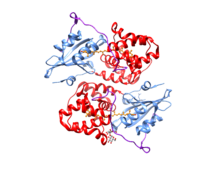
Accelerating Metagenomics Discoveries with Deep Learning

An example protein structure: the orange carotenoid protein. Proteins would be easier to align if they could be vectorized, acccording to Sevim. (Kerfeld lab group)JGI scientist Volkan Sevim is applying deep learning to genome science in order to make protein alignments more efficient. [Read More]

June 30, 2020

Ray Turner Completes Last Tour of Lab Duty at JGI

For the last 15 years, Ray Turner has been one constant for the Joint Genome Institute. His vigilant stewardship as JGI’s Operations Deputy has come to a close. [Read More]

April 29, 2020

JGI Earth Month: The Unusual Metabolism That Helps Plants Withstand Drought

Karolina Heyduk conducting research in growth chamber in both night and daylight conditions. The following info. is provided by Heyduk 1) I cut leaf samples and use them for RNA analysis. This gives us an idea of what genes are expressed in that tissue at the time I harvested them. 2) I take gas measurements because it tells us when the plant is conducting gas exchange – CO2 into the leaf, water vapour out. For C3 plants, this happens during the day. For CAM plants, gas exchange happens at night. Gas exchange patterns are a way for us to assess whether a plant is C3 or CAM. 3) Green light is needed at night because plant stomata (pores on the leaves that allow for gases to enter and exit) respond to blue and red light. Plants are green to us because they reflect green light back while absorbing red and blue! To avoid stomatal opening, we keep to green lights. A key trait of CAM photosynthesis is that plants take up carbon at night and fix it then, as opposed to doing it during the daytime, like C3 plants. Because CAM is active at night, we have to check for gas exchange and gene expression throughout the day/night cycle to capture both C3 and CAM traits.For JGI Earth Month, Karolina Heyduk, an evolutionary plant biologist at the University of Hawai’i at Mānoa shares how crassulacean acid metabolism, or CAM, helps plants take the heat. [Read More]

April 28, 2020

JGI Earth Month: Wetlands Work in #TenHundredWords

JGI Earth Month graphic orange 1000For JGI Earth Month, graduate student Mo Kaze took on the challenge of explaining her research using the ten hundred most commonly used words in the English language. Her work focuses anthropogenic impacts on wetland microbiome composition and metabolism. The #TenHundredWords Challenge was inspired by Randall Munroe’s xkcd comic “Up Goer Five” and his subsequent book Thing Explainer. [Read More]
Page 1 of 6912345...102030...»Last »

More from the JGI archives:

  • Software Tools
  • Science Highlights
  • News Releases
  • Blog
  • User Proposals
  • 2018-24 Strategic Plan
  • Progress Reports
  • Historical Primers
  • Legacy Projects
  • Past Events
  • JGI.DOE.GOV
  • Disclaimer
  • Accessibility / Section 508
Lawrence Berkeley National Lab Biosciences Area
A project of the US Department of Energy, Office of Science

JGI is a DOE Office of Science User Facility managed by Lawrence Berkeley National Laboratory

© 1997-2025 The Regents of the University of California