Archive

  • Visit JGI.DOE.GOV
Our Projects
Home › CSP Plans
Page 10 of 63« First«...89101112...203040...»Last »

September 22, 2017

Molecular Mechanisms of Parasitic Chytrids

Chytrids hinder algal biofuel cultivation by causing population crashes, but little is understood about how and under what conditions chytrids infect algae. Recently, researchers have found that the chytrid Paraphysoderma sedebokerense is a facultative algal parasite of Haematococcus pluvialis, whose trophic strategy is regulated by dissolved organic carbon availability. The molecular changes underlying its switch… [Read More]
September 22, 2017

Dynamics of Wetland Mangrove Ecosystems

Wetland mangroves are among the most productive ecosystems on the planet, generating a substantial amount of methane each year. Researchers know very little about how the microbial communities responsible for methanogenesis respond to climatic shifts. Since these communities experience strong subtropical seasonal and diurnal changes in light and temperature, the team aims to track temporal… [Read More]

September 22, 2017

Elucidating Viral “Dark Matter”

This proposal seeks to study viruses and microbes in nearly unexplored extreme environments including hydrothermal vents, glacial sea ice, and modern and ancient sea brines. The team will develop catalogs of which viruses are there, and use these to explore their genomes to identify genes the viruses have ‘stolen’ to augment a key microbial metabolism… [Read More]

September 22, 2017

Quantifying Cyanobacteria Interactions

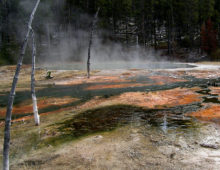
Yellowstone National Park, Octopus hot spring biofilms (Courtesy of Devaki Bhaya)Photosynthetic microbes play a major role in the Earth’s complex biogeochemical cycles. The vast populations of photoautotrophic cyanobacteria in the oceans, terrestrial and freshwater environments fix significant amounts of carbon and nitrogen. These phototrophic hosts are prey to viruses that release carbon and other nutrients, so the long term objective is to quantify dynamic interactions… [Read More]

September 22, 2017

Microbial Success in Legume-Rhizobia Mutualism

Recent advances have revealed the importance of microbes on plant and animal health. For plant productivity, no microbe-plant association is more important than that between rhizobia bacteria and legume plants. This symbiosis is the major natural contributor of nitrogen, a nutrient that limits plant growth in agricultural and natural systems. This work will identify genes… [Read More]

September 22, 2017

Iron- and Sulfur-Oxidizing Sediment Bacteria

Iron and sulfur are important elements to all life on Earth. Some groups of bacteria use iron and sulfur as energy sources and make organic carbon (sugars) from carbon dioxide in the atmosphere. These bacteria, known as iron- and sulfur-oxidizing bacteria, are found in the sediments and waters of the ocean and on land. They… [Read More]

September 22, 2017

Dynamic Behavior of Soil Ecosystems

By incubating soil with position-specific 13C-labeled glucose and determining the isotope distribution in the pyruvate that is produced, researchers will distinguish between two forms of glycolysis that may occur in intact microbial communities. Additionally, they will sequence DNA and RNA from soils and use that information to improve metabolic models. Improved understanding of microbial energy… [Read More]

September 22, 2017

Metabolic Diversity Across the Great Lakes

The Laurentian Great Lakes hold 20 percent of Earth’s surface freshwater and provide inestimable ecosystem services, yet surprisingly little is known about the structure and activity of microbial communities in this ecosystem. This project seeks to characterize the metabolic diversity and activity of microbes across the Great Lakes, and to understand how these microbes control… [Read More]

September 22, 2017

Gene Expression in Phlebiopsis gigantea

This project seeks to exploit the unique ability of the fungus Phlebiopsis gigantea to rapidly colonize freshly cut loblolly pine. Investigations will advance understanding of the early and exclusive deconstruction of coniferous wood by P. gigantea, provide a framework for functional analyses of hitherto unknown proteins, develop effective biocontrol strategies against economically important root rot… [Read More]

September 22, 2017

Genus-Wide Genomics of Trichoderma

Trichoderma is a genus of fungi that has a broad impact on mankind. There are approximately 270 species of Trichoderma fungi that have varied interactions with other fungi, animals, plants, and efficiently degrade plant biomass material. One species in particular (T. reesei) is well-established for production of enzymes used in the biofuel and biorefinery industries…. [Read More]
Page 10 of 63« First«...89101112...203040...»Last »

More from the JGI archives:

  • Software Tools
  • Science Highlights
  • News Releases
  • Blog
  • User Proposals
  • 2018-24 Strategic Plan
  • Progress Reports
  • Historical Primers
  • Legacy Projects
  • Past Events
  • JGI.DOE.GOV
  • Disclaimer
  • Accessibility / Section 508
Lawrence Berkeley National Lab Biosciences Area
A project of the US Department of Energy, Office of Science

JGI is a DOE Office of Science User Facility managed by Lawrence Berkeley National Laboratory

© 1997-2025 The Regents of the University of California