Archive

  • Visit JGI.DOE.GOV
Our Science
Home › Science Highlights
Page 13 of 26« First«...1112131415...20...»Last »

October 25, 2013

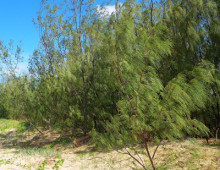
Root-dwelling denizen of Sheoak trees characterized

The complete genome of a novel nitrogen-fixing bacterium has been recently sequenced and analyzed. The Science The researchers isolated and sequenced the complete genome of a species of Micromonospora, bacteria that play a role in promoting plant growth and breaking down plant cell walls, from root nodules of Sheoak trees (Casuarina equisetifolia). The Impact Although… [Read More]
October 24, 2013

The heat is on – microbial mat communities in Hot Lake

Diverse underwater communities of cyanobacteria and other microorganisms are capable of withstanding drastic changes in salinity. The Science The microbial mat communities—multi-layered sheets of bacteria and archaea that grow at the interface between submerged, moist or even desiccated surfaces—in a remote lake near the border with Canada are relatively stable, despite weathering a 10-fold increase… [Read More]

October 21, 2013

Combining profiling and genomics yields novel metabolites

Cyanobacteria’s ability to capture solar energy and fix CO2 holds promise for biotech applications The Science Researchers studied 10 different cyanobacteria to identify their secondary metabolites (compounds produced during normal cellular metabolism not directly involved in cell growth, that may play an important role in interactions outside the cell) and the genes linked to those… [Read More]

October 18, 2013

DOE JGI Science Highlight: The inner workings of cyanobacteria carbon fixation

New research upholds theoretical structure for cyanobacteria carboxysomes. The Science Researchers described the structure of a protein critical to the outer shell of carboxysomes, the organelle-like structure that cyanobacteria use for carbon fixation. The Impact The structure and interaction of the proteins that make up the carboxysome’s outer shell aren’t clearly understood. A detailed study… [Read More]

September 30, 2013

Analyzing the Role of DNA Methylation in a Bioremediation Bacterium

Characterizing functional roles in a microbe with bioremediation applications a first step toward similar studies for other prokaryotes The Science Researchers studied the role of DNA methylation on gene expression and other processes in the heavy-metal reducing bacterium Shewanella oneidensis MR-1 with the help of next-generation Single-Molecule Real Time (SMRT) sequencers from Pacific Biosciences. The… [Read More]

September 13, 2013

Beetle gut microbes bore through woody tissues

Profile of wood-boring beetle’s midgut microbial community identifies candidate genes involved in processes including lignin degradation The Science Metagenomics allowed researchers to conduct a functional analysis of the midgut microbial community in the Asian longhorned beetle (Anoplophora glabripennis), an invasive insect that feeds on lignin in deciduous trees such as poplars and willows. The Impact… [Read More]

September 6, 2013

POPSEQ for Plant Genome Assembly

New approach allows researchers to work on many species regardless of sequence resources The Science Plant genomics researchers evaluated POPSEQ, a method for assembling complex plant genomes using next-generation sequencing. The Impact Using a large, complex and highly-repetitive plant genome, the findings yielded results comparable to the previously assembled sequence. The proof of principle demonstrates… [Read More]

August 30, 2013

Subsurface Sediment Yields Novel Organism

Metagenomic analysis emphasizes the “extraordinary microbial novelty” of poorly-explored subsurface ecosystems The Science Through metagenomics, researchers reconstructed a dominant organism and member of a new phylum-level lineage from an aquifer sediment in Colorado. The Impact Analysis of the complete microbial genome led to a detailed metabolic model with evidence for multiple new enzymes and pathways…. [Read More]

August 23, 2013

Hope for Re-establishing Gulf of Mexico Microbial Populations

Comparative Analysis Shows Petroleum Reduced Species Diversity The Science Researchers used metatranscriptomic analyses to compare the microbial populations in the Gulf of Mexico before and after the Deepwater Horizon oil spill to learn more about the impact of adding petroleum to the waters. The Impact Though the oil spill reduced the diversity of the microbial… [Read More]

August 16, 2013

Solving the Secrets of Sedimentary Microbes

Microbes from Phylum Chloroflexi Provide Clues to Carbon Cycling, Respiration in Sediments The Science Through metagenomics, researchers sequenced 86 organisms from the phylum Chloroflexi that represent 15 distinct lineages in order to discover the secrets of microbial life within terrestrial aquifer sediment deposits. The Impact These Chloroflexi microbes were found to have metabolic processes involved… [Read More]
Page 13 of 26« First«...1112131415...20...»Last »

More from the JGI archives:

  • Software Tools
  • Science Highlights
  • News Releases
  • Blog
  • User Proposals
  • 2018-24 Strategic Plan
  • Progress Reports
  • Historical Primers
  • Legacy Projects
  • Past Events
  • JGI.DOE.GOV
  • Disclaimer
  • Accessibility / Section 508
Lawrence Berkeley National Lab Biosciences Area
A project of the US Department of Energy, Office of Science

JGI is a DOE Office of Science User Facility managed by Lawrence Berkeley National Laboratory

© 1997-2025 The Regents of the University of California