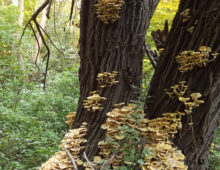
Comparative genomics involving humongous fungus helps explain evolution of Armillaria Among the contenders for the world’s largest living organism is something usually considered much smaller than a blue whale, or a towering sequoia. This particular organism is so big, one needs an aerial map to grasp its size, and even then it’s not completely visible…
Cat Adams, University of California, Berkeley

“If we can assemble genomes, we can learn some of these strategies to reduce bias.” I study the role of secondary metabolites, especially defensive chemistry and how they influence plant-fungal interactions. For my Ph.D., I’m studying a mushroom called Amanita phalloides, the death cap mushroom. It’s native to Europe but it was brought overseas…
JGI’s Klatu Chills at the North American Freezer Challenge
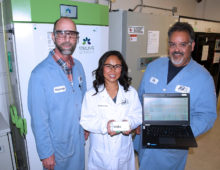
Freezer Preventive Monitoring Program A Model of Berkeley Lab Energy Efficiency Efforts It’s a common scene in popular culture, and it likely plays out in your own home: someone looking for a snack holds the refrigerator door open so long that eventually someone else complains that its cold enough for penguins to migrate from the…
Tracking the Viral Parasites of Giant Viruses over Time

Virophage database doubles with discovery in freshwater lakes datasets. In freshwater lakes, microbes regulate the flow of carbon and determine if the bodies of water serve as carbon sinks or carbon sources. Algae and cyanobacteria in particular can trap and use carbon, but their capacity to do so may be impacted by viruses. Viruses exist…
Liverwort Genes and Land Plant Evolution
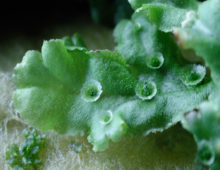
Genome analysis of early plant lineage sheds light on how plants learned to thrive on land. Though it’s found around the world, it’s easy to overlook the common liverwort – the plant can fit in the palm of one’s hand and appears to be comprised of flat, overlapping leaves. Despite their unprepossessing appearance, these plants…
A Technique for Targeted Improvement

Establishing a genome-wide map of bacterial genes crucial for colonization of plants by beneficial microbes The Science Working with the plant growth-promoting bacterium Pseudomonas simiae, researchers have identified 115 genes that negatively affect its ability to colonize a plant root system when mutated. The Impact A plant’s health and development is influenced by the complex…
Benchmarking Computational Methods for Metagenomes
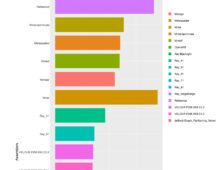
Community-driven CAMI Challenge offers analysts, scientists insights on the right tools for their research questions. They are everywhere, but invisible to the naked eye. Microbes are the unseen, influential forces behind the regulation of key environmental processes such as the carbon cycle, yet most of them remain unknown. For more than a decade, the U.S….
2018 DOE JGI Community Science Program Allocations Announced
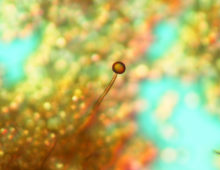
Proposals encompass multiple capabilities of the national user facility Though organisms can be studied in isolation, a more comprehensive picture emerges when their environmental interactions are taken into account. Along the same lines, many of the 30 proposals selected for the 2018 Community Science Program (CSP) of the U.S. Department of Energy Joint Genome Institute (DOE…
From Genome to Watershed Scales

The quality of water that leaves the watershed is impacted by soil microbial communities that will be studied here. The research will target regions along the East River, a tributary of the Colorado River, focusing on three subsystems: the river corridor and hillslopes and consider effects of time of year, depth below the surface and…
Microbial Functions at Soil-Aquatic Interfaces
47-55 percent of the terrestrial carbon is transported and processed in rivers. Terrestrial carbon is generally considered to be resistant to aquatic microbial metabolism. However, recent evidence suggests that at soil-aquatic interfaces terrestrial carbon can be respired by aquatic microorganism at the cost of low carbon use efficiency thus contributing to CO2-fluxes to the atmosphere….